

Can An Oscilloscope Be Used In Repairing Bulova Accutrons


Hello fellow electronics enthusiasts! In Part one, I showed you some photos of the amazing Accutron 214 components and gave you a basic clarification of them and how the movement operates. In this commodity nosotros will take a deeper wait at the electronic circuit and the indexing machinery. In Role 3, we will have the motion cleaned and reassembled to examination and see if information technology works. If it doesn't work, nosotros volition repair it – which may need a Part iv: nosotros shall run into.
Looking at the schematic of the electronic circuit of the Accutron, it seems to exist very uncomplicated. It is uncomplicated – only it is also very elegant. Not simply does the circuit control the pulsed current with its fixed coils and tuning fork cups/conical magnets, information technology also has an inherent built-in amplitude command organisation.
Equally I mentioned in Role 1, about 25% of the turns of Drive Coil 1 (DC1) brand upwards the phase sensing curl. It is the phase sensing gyre that controls the instant the pulses of current are practical to the bulldoze coils to maintain the tuning fork oscillations. The coils are fixed to the pillar plate and the tuning fork cups with their associated magnets are attracted or repelled depending on the polarity (management of the electric current period). So the coils with their associated magnets serve three functions; they drive the tuning fork by converting pulses of electrical current into mechanical impulses, they control the power in which the electronic circuit may sense the tuning fork amplitude, and they control the instant in the tuning fork cycle during which the driving current pulse is delivered to the coils.

Hither is the schematic and the photograph of the movement showing the components from Part i for you lot to refer to.
The 220nF cap in parallel with the 3M9 resistor keeps the transistor in the not-conducting state throughout near of the cycle of the tuning fork. As previously explained, the alternating pulses of voltage are induced in the phase sensing coil past the oscillations of the magnet associated with it. Through the base of the transistor this voltage is added to the battery cell voltage to charge the cap in one case each wheel past the peaks of the alternating voltage induced in the phase sensing coil. These recharging pulses of electric current cause the transistor to conduct momentarily and allow electric current to menstruation in the bulldoze coils to pulse the tuning fork and maintain its oscillations.
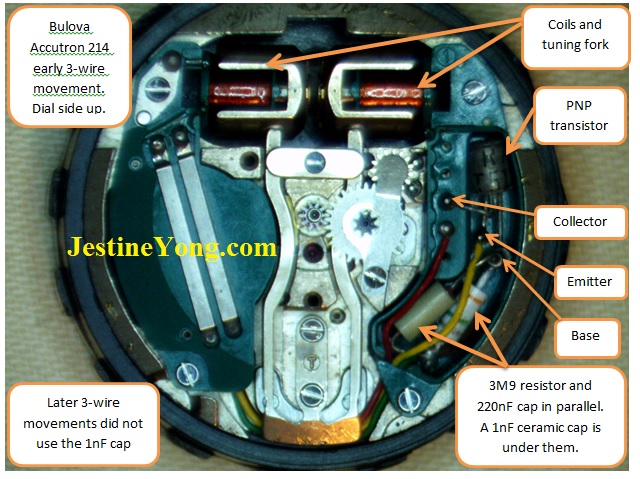
The transistor is caused to conduct at the indicate where the voltages induced in the phase sensing coil and drive coils are virtually their maximum instantaneous values, and when the bulldoze coil induced voltage is opposite in polarity to the bombardment prison cell voltage. Therefore, if the amplitude of the tuning fork at the instant the transistor conducts electric current and the induced voltage in the drive coils exactly equals the battery cell voltage, no current would period since the two voltages are contrary in polarity which would crusade them to cancel each other out.
Then, the pattern of the magnet and coil organisation is the key to the operation of the amplitude control system so that the proper amplitude of oscillation for the tuning fork, the voltage induced in the drive coils has a superlative value about 10% less than the battery jail cell voltage. It is because of this that a 10% increase in amplitude resulting from a disturbance, such every bit the motion being bumped or jarred, would cause the driving current pulses to be reduced to nada and the tuning fork would chop-chop render to its proper aamplitude. Also, a ten% decrease in amplitude of the tuning fork would cause the driving current pulses to double and once again render the tuning fork very quickly to the proper amplitude.
As I previously mentioned, one of the tines of the tuning fork has an index finger and jewel which moves the index cycle to plough the scout wheels and easily as the tuning fork vibrates. It is called the ratchet system. Even though the ratchet system is very tiny it does not change the physical principles of its operation in any way. Below is a photo that gives a bones view of the index wheel ratchet arrangement.

When the tuning fork tine oscillates it moves the index jewel to advance the alphabetize wheel in the forward direction as seen in the photo above. The pawl precious stone drops into a tooth preventing the alphabetize bicycle from reversing direction past the advanced tooth when the index jewel pulls back in the reverse direction by the tuning fork. The jewel fingers go on a little downward pressure (torque) against the index cycle which keeps them from jumping away from the alphabetize wheel and also mimics the draw in a mechanical scout escapement by pulling the index wheel dorsum a footling so that the pawl jewel rests at the step in the alphabetize wheel. To learn about mechanical watch lever escapements you can look here . The lever escapement is the most common that you will probably be acquainted with. You tin explore other types of escapements from links on that folio if yous wish.

In the simplified photo above of the index wheel teeth and jewels, we run into how the jewels accelerate the index wheel under unlike amplitudes. Figure (A) shows the movement stopped at the residuum position. Figures (B) & (C) prove the end of the forward/return strokes of the 1-tooth amplitude. Figures (D) & (E) evidence a two-tooth aamplitude, with figure (F) showing the middle of the two-tooth render stroke. Figures (1000) & (H) show the three-molar amplitude.
Using the distance between the teeth every bit a measure of the amplitude, we can encounter what happens when the tuning fork vibrates at diverse amplitudes. Figures B & C evidence a consummate cycle of oscillation at an aamplitude of one-tooth (from ½ tooth right to ½ tooth left of the balance position). You can come across that when the index jewel moves ½ tooth to the right, the alphabetize jewel picks upwards some other tooth and on its return stroke to the left it pushes the index wheel far plenty for the pawl jewel to drop off of the terminate of tooth # ii and so that we take advanced a movement of one molar. From this we can deduce that further oscillations at the amplitude of one tooth will advance the index cycle one tooth per bike.
In figures D, E, and F we tin can see what happens when we increment the amplitude to two teeth (i tooth right to 1 tooth left of the rest position). Notice that when the index jewel moves one molar to the right, it drops off of molar #seven and moves halfway along tooth #8. So on the return stroke to the left the start one-half tooth of travel causes no move of the index bike since the index jewel does not outset to push the index wheel until the index precious stone reaches molar #vii. Besides observe that in figure E, molar #two passes beyond the pawl precious stone; but after the offset of the return stroke back to the right the "depict" effect exerts force on the alphabetize bicycle to pull it back ½ a molar confronting tooth #2, as shown in figure F.
Figures G & H show the result of a three-tooth amplitude. Note that when the index jewel moves 1 ½ teeth to the right the alphabetize jewel will pick upwardly molar #viii. At the stroke to the left the alphabetize jewel has moved tooth #viii into the position where molar #five was.
The pawl jewel dropped off the end of tooth #4, and nosotros have accomplished a iii-tooth advance of the index wheel.
So we tin see that for any aamplitude from merely over one tooth to just under three teeth the index bike will but advance 1 tooth for each oscillation of the tuning fork. Nosotros accept demonstrated that the Accutron index mechanism permits wide variations in tuning fork amplitude before the movement easily neglect to advance in exact synchronism with the oscillations of the tuning fork.
Find also that the jewels rest flat confronting the index wheel teeth. This helps distribute the already minute forces property the jewels against the index wheel to help go along them from wearing out. According to the Accutron manual, they examined movements that had been running for years, and subsequently examination could find no signs of habiliment. I tin believe it. My own examinations in the coming years will tell if that is true simply I doubt that Bulova would make that merits if information technology were non truthful. And how old an Accutron is that I purchase is no guarantee because I have no way of knowing exactly how long it really ran during its life. I can say that I have not seen any prove of wear in my 214'south index wheel and jewels.
The adjacent few photos are of the Accutron 214 movement being taken autonomously.

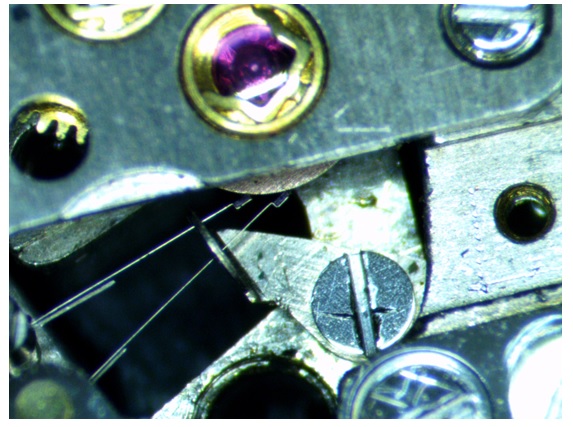

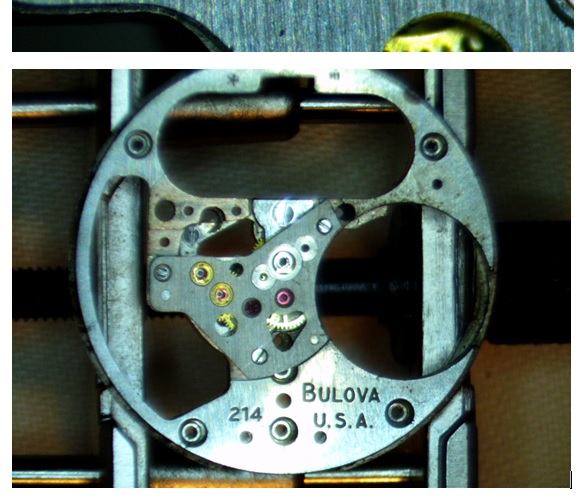
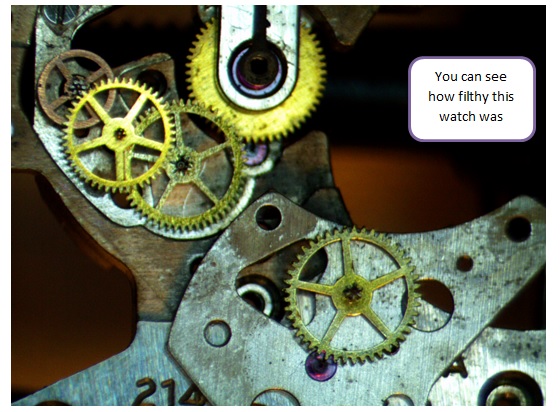


In Role three we will go the cleaned movement dorsum together and run some checks.

Robert Calk is a hobbyist from the USA who loves Electronics, Leatherworking, and Watchmaking.
Please give a back up by clicking on the social buttons below. Your feedback or comment on the post is welcome.
P.South- Do you know of whatever your friends who would benefit from this content that you lot are reading at present? If then, forward this website to your friends or you lot tin invite your friends to subscribe to my newsletter for costless in thisLink.
Please check out his previous repair commodity beneath:
https://jestineyong.com/bulova-accutron-214/
Likes (81) Dislikes
 (1)
(1)

Source: https://jestineyong.com/bulova-accutron-214-part-2/
Posted by: mcdonaldcaliat.blogspot.com
0 Response to "Can An Oscilloscope Be Used In Repairing Bulova Accutrons"
Post a Comment