

How Can I Repair Chipped Edges On My Concrete Driveway
How to Fix Sidewalks That Are Chipped and Pitted
Updated: Jun. 24, 2022
Coil downward your sleeves and put on a grit mask. Making a durable patch is a dusty, grimy thing.
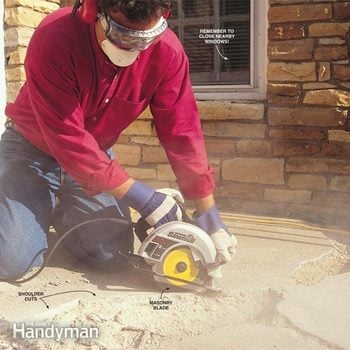
Extend the life of old concrete by fixing broken, aging areas before the problem gets worse. A properly done repair will last decades. We'll show y'all how to create a durable concrete patch to ready 2 of the nigh common problems: spalling and broken corners.
You might also like: TBD
- Fourth dimension
- Complexity
- Cost
- A total day
- Intermediate
- Less than $20
Physical Patch: Size up the chore before y'all begin

Masonry bract
A corundum masonry blade grinds through concrete, but slowly. A diamond bract costs more but cuts much faster.
Physical is hard stuff, but don't permit that intimidate yous. With the proper tools and techniques we testify in our photo series, even a novice can brand a durable patch, offset try. Sawing concrete with a special masonry blade (opening photograph) may be new to yous, but if you lot've handled a circular saw, y'all'll rapidly go the hang of it. It's less chancy than sawing wood. Yet, the blade kicks up an incredibly thick deject of abrasive dust, and so be sure to wear goggles to protect your eyes, ear protection, gloves and a grit mask, as well as one-time clothes.
Size up the task first. Earlier first whatsoever repair, assess the general status of the concrete slab. (See "Patch or Replace? " below) Sometimes the all-time strategy is to break out an entire section and repour it with new concrete rather than patch it. Patching works all-time for local damage in otherwise sound concrete.
Nosotros won't bargain with the other common problem, cracks. You can repair them exactly as we testify here, but they'll nigh probable render unless you can stabilize the concrete slab to prevent the movement that caused the cracks in the first identify.
If this is your commencement physical repair projection, let nearly a one-half day to pick up materials and complete two to three patches. Information technology took usa almost four hours from start to end to complete the 2 repairs we evidence here.
Complete the job during comfy working conditions, ideally in dry atmospheric condition with a temperature betwixt fifty and lxxx degrees F. Both you and fresh physical happen to agree on this 1. Fresh concrete is easiest to handle and hardens all-time (a process technically chosen "setting" and "curing") in this temperature range. Colder weather lengthens the setting time; freezing temperatures tin ruin the concrete. Hotter weather causes faster setting and drying; the slab may harden before you can smoothen it. Or the surface can dry out too fast and not harden properly, eventually causing it to spall. In hot weather, piece of work in the libation mornings or in the shade.
Patch or Replace?
Should you patch your erstwhile concrete or completely tear it out and repour it? While there's no difficult and fast dominion, here are some tips to guide your decision:
- Appraise the severity of the damage. If your driveway is full of spalled areas and cleaved edges, the surface is probably severely weakened. It'll go along to deteriorate, and chances are the patches won't last.
- Call in a concrete contractor (Search "Concrete Contractors" on your browser) to help you assess the situation and ask for a cost on consummate replacement. But keep in heed that contractors are in the business of selling physical. With their labor costs, it's usually cheaper for them to replace than repair. We had problem finding a contractor who would even do patching.
- Is appearance of import? A patch will exist lighter-colored than the former concrete. Even after weathering for a few years, the new patch will probably still stand up out. One way to hide the patch is to stain the unabridged surface to blend the old with the new. Merely you'll accept to renew the stain periodically.
- How much are you willing to spend? Material costs for a repair are low. Pros would desire to completely supplant the slab to insure a high quality result. The cost would be substantial.
Repair spalled areas: Cutting out the harm
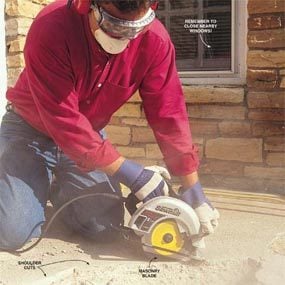
Photograph 1: Cutting around the chipped surface area
Cut a three/8-in. to ½-in. deep "shoulder" around the edge of the spalled area with a saw and masonry bract. Movement the saw slowly equally you cut. Make sure you cut back into solid physical to ensure a potent bonding surface.
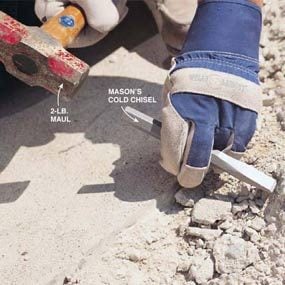
Photograph 2: Chisel out weak areas
Break out all weak and loose concrete with a maul and cold chisel. Precipitous concrete chips volition come flying out, so wear safe goggles.
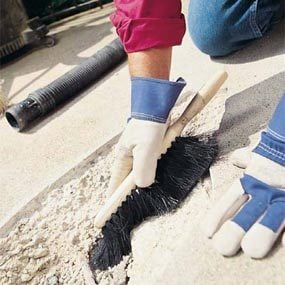
Photo three: Castor away droppings
Clean the chips and dust from the repair area with a broom or shop vacuum. Be thorough. And then mix the patching material.
"Spalling" is the mason's term for concrete that'due south pitted or chipped, as in Photo 1. The key to a lasting repair is to make a saw cutting around the perimeter of the damaged area, cutting back to solid concrete. The cutting should be at least three/eight in. deep: Most repairs that fail do and then considering the patch is too thin at the edges and breaks off. Set a masonry blade (see to a higher place) at a 5-caste angle so the cutout is slightly wider at the bottom than at the top. This helps "lock in" the patch (Photo one). Slowly guide the saw through the physical. The masonry blade grinds a groove, and then don't put a lot of force per unit area on the saw; allow the bract do the work. Cutting about 1/4 in. on each pass. A diamond grit blade can cutting the concrete about 5 times faster than a masonry blade, and it won't wear out every bit fast. But it besides costs more. The actress price is worth it if you have more nigh 10 ft. of concrete to cut. Or save money—and time—by renting a diamond blade (about a day, plus vesture fee), or a concrete saw with diamond blade.
Tip: You'll heighten an impressive dust cloud when sawing, so close up nearby windows and doors. Otherwise, you lot'll be housecleaning, besides!
Once you've cut and thoroughly cleaned loose concrete from the repair area (Photos 2 and iii), moisten the surface area with a wet sponge before packing in the physical mix. Don't leave standing water in the patch surface area; utilize just plenty to dampen the old concrete and aid information technology bond to the new.
Repair spalled areas: Pack in the repair mix

Photograph 4: Moisten and fill
Moisten the patch area with a wet sponge. Then pack in the patch mix with a wood bladder. Leave the mix slightly college than the surface of the old concrete.
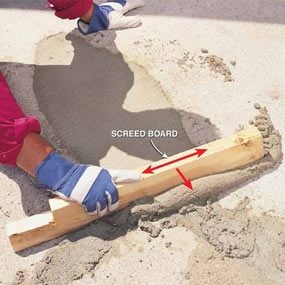
Photo five: Screed off the excess
Screed off the excess material past sliding a board side to side in a sawing motion while pushing information technology forward. If you find low spots, pack in more mix and screed off once more.
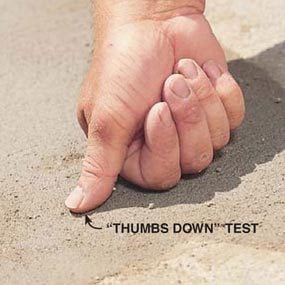
Photo 6: Allow the concrete stiffen
Test the compactness of the patch by lightly pressing your thumb on the surface. When your thumb no longer leaves an indentation, become ahead and finish the surface.
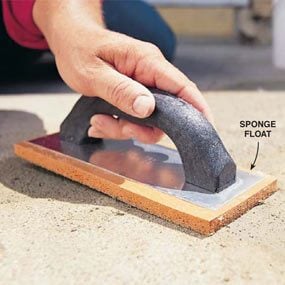
Photo 7: Bladder the surface
Match the texture of the old, crude concrete by rubbing the surface of the patch with a sponge float. Use a steel trowel for a smooth stop or a stiff bristle broom for a lightly grooved end.
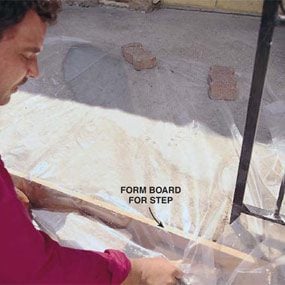
Photograph eight: Encompass with plastic
Comprehend the patch with plastic to retain the wet. Weight down the edges to keep the plastic from blowing off. Concrete requires moisture to cure properly.
For your patching mix, apply either a prepackaged sand mix or concrete mix, depending on the depth of the patch. (See "Use the Right Patching Mix, " below.) Each 60-lb. bag makes well-nigh 1/2 cu. ft. of concrete, enough for a ii-in. thick patch about 1 ft. wide by 3 ft. long. Approximate the volume of patching material by multiplying judge length, width and thickness (in anxiety) to make it at cubic feet, and buy a fleck more than you recall you'll need. Meliorate to have too much than to fall a few scoops short!
Mix it with water and acrylic fortifier, post-obit the mixing directions on the package. The fortifier strengthens the new physical and helps it bond better to the old concrete. The mix should be merely wet enough to hold together when it's troweled into the repair. Don't add too much h2o. It'll result in weaker concrete.
We used a normal sand mix, which sets hard enough to walk on in about a day or two. Information technology continues to cure and harden for weeks. If you take to use the area correct abroad, you tin purchase a special fast-setting concrete, which hardens in virtually an hour. Information technology costs nigh twice as much and you won't accept as long to spread and shine it, and so stick to the regular mix when possible. Virtually building supply dealers that deport regular physical also carry the fast-setting type. After mixing the concrete, pack it firmly into the repair area using a wood bladder (Photo iv), the tighter the improve. Mound the mix and then it's slightly higher than the quondam concrete. And so immediately level it even with the old concrete using a directly board (Photograph 5).
Begin finish trowel work when the surface moisture starts to evaporate and the patch begins to harden. It may only be x minutes on a warm day or possibly an hr on a cool day. One sign of evaporation is the loss of some of the surface gloss. When the patch appears to be getting stiff, exam it with your pollex (Photograph 6). Once the surface is about as stiff every bit the skin of a grapefruit, begin the finish work. We used a sponge bladder (Photograph 7) to friction match the slightly rough texture of the old concrete. A sponge bladder has a rough safe surface. If yous want a smooth surface, use a steel trowel; for a lightly grooved appearance, elevate a strong-bristle broom across the surface.
Later on using a float on the surface, cover the patch with plastic for 2 days. The plastic helps the concrete retain the moisture, which the concrete needs to cure and strengthen (Photo 8).
Circumspection!
Moisture concrete is highly alkali metal and can crusade severe burns to bare pare. Immediately wash off any that gets on your skin with cool water.
Use the Right Patching Mix
Concrete mix consists of sand, gravel and Portland cement. The gravel reduces shrinkage, so it won't crack as readily when laid in thick. All the same it may not bond well in thin layers. Sand mix (sometimes called topping mix) consists of sand and Portland cement. It'due south easier to trowel in thinner layers (to about 1/4 in. minimum) for thinner patches or patches with thinner edges. However, if you apply information technology thicker than ii in., its natural shrinkage might cause information technology to crack or break the bail with the former concrete. In a nutshell: Use a sand mix for repairs less than 2 in. deep. Use a physical mix for repairs deeper than 2 in. Replace 50 to fourscore pct of the water with the acrylic fortifier in either mix to improve the patch'southward bonding strength.
Concrete Patch: Repair broken corners
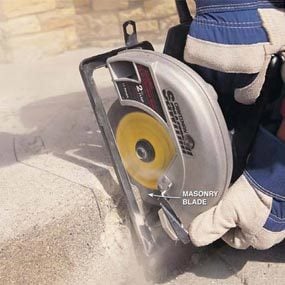
Photo 9: Cut around the footstep impairment
Square off the edges of the broken pace with a masonry blade. Fleck out loose and weak concrete with a cold chisel.
Close-up of Photo 9
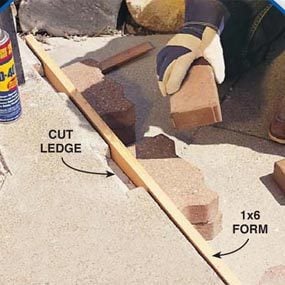
Cut the underside of the intermission likewise to brand a firm ledge.
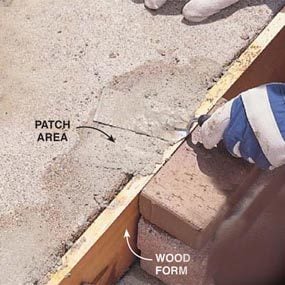
Photo 10: Form the repair and pack in patching mix
Anchor a form board against the side of the step, moisten the surface area and pack in the repair mix. Screed off the excess patching material.
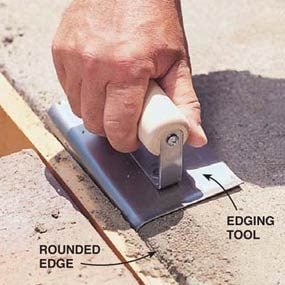
Photo eleven: Round the border
Slide an edging tool along the step edge to circular it. Use the edging tool only if the old stride portion has a rounded edge.
Utilise the same basic patching technique for a broken corner as for spalled areas, merely add three key steps.
- Create a ledge for the patch to make a stronger bond with the erstwhile physical (Photos 9 and 10). Don't exist afraid to make the cutout well beyond the edges of the original damaged area. Smaller patches simply won't agree as well as larger ones.
- Prop a wood form tightly against the vertical portion of the step to hold the physical patch in identify (Photo 10). Block the grade against the step with bricks or other heavy objects. Tip: Coat the wood form with motor oil or WD-forty to keep the physical from sticking to the woods.
- When the concrete begins to set, use the edging tool to create a slightly rounded edge to friction match the step (Photo eleven). Then remove the grade board (carefully, because the concrete is all the same soft) and finish all exposed surfaces with a float or trowel to match the texture of the onetime physical. Cover the patch with plastic and let it cure for at least 2 days earlier walking on information technology.
Required Tools for this concrete patch project
Have the necessary tools for this DIY project lined upward before you start—you'll save time and frustration.
You will also need a 2lb. maul, wood float, sponge bladder, edging tool, broom and a masonry bract.
Required Materials for this concrete patch projection
Avoid last-minute shopping trips by having all your materials set ahead of time. Here'southward a list.
Originally Published: June 24, 2022

How Can I Repair Chipped Edges On My Concrete Driveway,
Source: https://www.familyhandyman.com/project/how-to-fix-sidewalks-that-are-chipped-and-pitted/
Posted by: mcdonaldcaliat.blogspot.com
0 Response to "How Can I Repair Chipped Edges On My Concrete Driveway"
Post a Comment